Posts

The Lactobacillus Hustle

Image
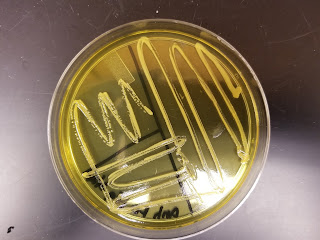
I was completing inhibition assays on my lil' Lactobacilli. I was trying to determine if they could inhibit the growth of a food pathogen like E. coli. So, I got a petri dish filled with MRS agar, dug a well, and inserted 500 microliters of MRS broth inoculated with a 24 hour, undiluted culture of each of the Lactobacillus species, acidophilus, plantarum, and rhamnosus. Then I spread lil E. coli around the top of each of the wells. All the research I read indicated that the two did not make good roomates, but what happened next could not have been anticipated. E. coli just had his run of the place. I asked the Lactobacilli what happened. They informed me that E. coli was nice but could be a little aggressive at times. It was difficult keeping the place tidy while he was around. They suggested that I leave them alone in the well  and then bring E coli by in a couple days. So I did. I left them alone in the well before I moved in E. coli. However, I was bamboozled! Lil' L...

Johnny on the Spot-Part II

Image
From previous conversations with Johnathan, I knew he was a numbers guy, so I decided to to ask if he could help me with my dilemma. You know what?...Johnny on the spot came right through like I knew he would. This idea is so amazing that I couldn't believe it. He suggested using a type of cohort analysis to calculate the missing part of the growth curve. My calculations indicated that I would miss the transition occurring around 16 hours. Johnathan suggested to get another culture started around 5:00 pm, and come the next day at 9:00 am (16 hours later) and record what I missed. Awesome...right? Turns out I didn't miss a thing after all.

Johnny on the Spot

Image
I don't know how many of you have met our fellow STEM student Johnathan, but he is the tall guy with glasses. He's kinda funny, very nice, and super smart. I was chatting with him one day and realized that he was a mathematical genius. Which was convenient because I had a mathematical predicament. I was trying to calculate a growth curve for three species of Lactobacilli. However, after collecting some preliminary data and calculating a few estimations, I realized that I would miss an important change in my bacteria. Unlike E. coli, Lactobacilli take much longer than 10 hours to complete their growth cycle. After asking to stay after hours, I was informed that the lab had not been Rolanda proofed, so I couldn't stay pass 5:00 pm. Facing this conundrum, I decided to consult with Phoenix college's brain trust- Matt and Josh. They came up with the idea of monitoring carbon dioxide levels during the period when I wasn't there. Then I could use the data to...

New Semester...New Project

Image
Every time I start a project, I always think that I'm going to kick that football right away. And then life happens, and I'm flat on my back. This semester I have decided to examine the inhibitory effects of lactic acid producing bacteria on two common food pathogens: E. coli and Salmonella. In my mind I had this laid out perfectly. In my gut, I knew this wouldn't be easy, but I think my enthusiasm kept me from seeing how difficult it would really be. Nevertheless, I will persevere. And by the end of the semester, I will have kicked that football.

Rolanda's Bio

Image
I have always known that Science was a subject I wanted to study. I received my first microscope when I was 8 years old, and have participated in every Science fair since the 5 th grade. In high school, I developed a real interest in bacteria, and centered by next 3 Science fair projects around Microbiology. I would schedule my study halls around my Science teacher’s break, and she would let me culture random things to see what would happen. She was the one who encouraged me to pursue a career in Science.   

Staphylococcus Aureus

Image
                                                                                            Staphylococcus Aureus on Mannitol Plate S. Aureus was identified in two of the participants in my study. Although this organism is typically described as an opportunistic pathogen, it is a part of the normal skin flora of approximately 1/4 of the US population. S. Aureus is also associated with dry skin and atopic dermatitis (Williams et al, 2017). Consistent with current research, the person in our dry skin condition had the most colonies of S. Aureus when compared to the participants with normal and combination skin.  Biochemical characteristics of S. Aureus include, mannitol  +, coagulase +, glucose +, lactose (+) or (-) , and anaerobic.

Meet Cory

Image
                                                                                                                      Corynebacterium on blood agar Hello STEM Family, I’d like you to meet my friend Cory. Cory is long, dark, and radiates positivity. I know what you’re thinking, but currently Cory is cohabitating with S. Epidermis on Mt. St. Nares. They’ve been together for the last thirty days. However, if you want to   meet a special friend like Cory, here’s what to look for. They have to be comfortable swimming in shallow and deep water as there is little oxygen down there; have an insatiable sweet tooth, lactose tolerant, and a bubbly personality. Corynebacterium and S. Epid...

Welcome to the Microbiome

Image
 Each of the photos represents a skin type. The faces were colored purple to represent the places where gram positive bacteria was identified and pink to represent where gram negative bacteria was identified. The project has identified familiar bacteria like S. Aureus and S. epidermis and less familiar bacteria like Veillonella Dispar and Staphylococcus Schleiferi. (more below) Combination Skin                                                                                                                                                                         ...

Lessons Learned

Image
So I started my project and realized that all my timelines would be busted. When I started mapping out the microbiome by skin type, I knew it would be a lot of work. However, my 8 year old self has dreams of changing the world. Who am I to say that she shouldn't at least try. Anyway, my older and wiser self  just wanted to share the important lessons I've learned so far.  If you are using the Bergey's Manual of Determinative Bacteriology, then there are 3 tests you should run right after gram staining: 1) test for oxygen requirements (facultative, anaerobic, aerobic), 2) test for catalase, and 3) determine if the bacteria can ferment carbohydrates (start with glucose 'cause it's already in the refrigerator). This book highlights in bold black letters, the results of these 3 tests at the beginning of every chapter.  The other lesson I learned concerns the order in which I ran the tests. I grouped the bacteria by whether they were gram negative or posit...

STEM Project: Identifying the Human Microbiome by Skin Type

Image
Hi Everyone, For my project, I intend to map out the human microbiome by skin type. Ultimately, I would like to identify how to use bacteria to treat skin infections associated with particular skin types. For example, if a person with dry skin also suffers from atopic dermatitis, then theoretically, one could apply healthy bacteria to the skin in order to relieve the symptoms of the infection.  Just imagine...instead of seeing a dermatologist in a doctor's office, you can go to the spa. There, the "staph" would culture the bacteria on your body and develop treatments just for you. Yes…I just put the tin foil hat on.  I know it seems like I’m dreaming, but there are start up companies out there who think that probiotics in creams are a viable solution for people suffering from various skin conditions. However, I think the right approach is to customize the products because you don’t want to introduce bacteria that will upset the balance in your microbiom...

Mathematics, Engineering and Science Achievement (MESA)

Just wanted to share some good news. My oldest daughter is a member of the MESA club at Vista del Sur Elementary School in Laveen. She is a part of the On-Site Engineering Design group. In this competition, the students show up at their destination and are given a task. They receive $500 in monopoly money to buy all the supplies they need to complete the project. At regionals, her group was required to build a shelter for an egg so that it wouldn't break when dropped. Her group's design got them second place and now they will be participating in the state competition at Apollo High School in April!!!  GO Tigers!!!!

A Chat with My Informants

First I spoke with Oxidase, but he could tell me nothing. As a matter of fact, he seemed quite negative about the whole thing. My next stop was G. Fermentation's restaurant. She said the last time she saw E3AM7C was a few days ago. She did notice something strange. The pink beauty only ordered a glucose cocktail for dinner. G. Fermentation wasn't quite sure of the pink beauty's whereabouts, but thought she could be headed to SIM's place. On my way there now...

The Elusive Pink Beauty

Image
Victory is miiinnneee! After many hours of investigation, I discovered that the long, rod shaped, pink beauty is gram negative. However, I still don't know her name. My instincts tell me that I should be talking to some folks in the bacillus colony. Stay tuned.....

Gram Staining

Yesterday, I began the process of gram staining. Unfortunately, for the last 24 hours, the true nature of bacteria E3AM7C has remained hidden from me. However, today....armed with another lab manual, youtube videos, and the expansive knowledge of lab assistant Matt, I am determined to be victorious!